1. Abdi, H., Mirshah Jafari, S.E., Nili, M.R., & Rajaeipour, S. (2017). An explanation of the future curricula toward realizing the visions and missions of Iranian higher education in horizon of 2025. Journal of Higher Education Curriculum, 8(16), 59-88 [in Persian].
2. Altbach, P.G. (2010). The realities of mass higher education in a globalized world. In Higher education in a global society. Edward Elgar Publishing.
3. Amini, M., Marooghi, R., Mazidi, M., Torkzadeh, J., & Mohammadi, M. (2015). An investigation into the outcomes of implicit curriculum in higher education. Journal of Theory & Practice in Curriculum, 5(3), 23-44.
4. Bagheri, K. (2018). One Dream and Two Beds: De-stressing the University and the Humanities. Tehran: Institute of Cultural and Social Studies [in Persian].
5. Barnett, R. (2000). Supercomplexity and the curriculum. Studies in Higher Education, 25(3), 255-265.
6. Barnett, R. )2009(. Knowing and becoming in the higher education curriculum. Studies in Higher Education, 34 (4), 429-40.
7. Barnett, R., & Coate, K. (2004). Engaging the Curriculum. McGraw-Hill Education (UK).
8. Bernstein, B. (2000). Pedagogy, Symbolic Control, and Identity. Rowman & Littlefield Publishers.
9. Carroll, M. (2018). Understanding curriculum: An actor network theory approach. Studies in Self-Access Learning Journal, 9(3), 247-261.
10. Clegg, S. (2011). Cultural capital and agency: Connecting critique and curriculum in higher education. British Journal of Sociology of Education, 32(1), 93-108.
11. Cornbleth, C. (1990) Curriculum in Context. London: Falmer Press.
12. Davoodi, A., Keshtiaray, N., & Yusfi, A. (2016). Phenomenological explanation of curriculum principles of the teaching experience (internship) in Farhangian University. Journal of Theory & Practice in Curriculum, 6(3), 5-28 [in Persian].
13. Fathi Vajargah, K. (2017). Moving beyond reconceptualisation toward recontextualisation/multicontextualisation of curriculum studies in Iran. Journal of Higher Education Curriculum Studies, 9(18), 45-69 [in Persian].
14. Ghorbani, H. (2019). Designing and validation of internship curriculum pattern based on collaborative autobiography in teacher education in Iran. Theory & Practice in Curriculum Journal, 7(14), 395-442.
15. Hicks, O. (2018). Curriculum in higher education: Confusion, complexity and currency. HERDSA Review of Higher Education, 5, 5-30.
16. Hosseini, L.S.M., & Yadegarzadeh, G.R. (2021). University curriculum development models in higher education: A proposed model for higher education in Iran. Journal of Higher Education Curriculum Studies, 11(22), 49-88 [in Persian].
17. Javadipour, M., Hakimzadeh, R., & Abadi, F. (2016). A review over the new concept of college student’s curriculum: Introducing and expanding the relevant concepts. Journal of Higher Education Curriculum Studies, 8(15), 91-112 [in Persian].
18. Johnson-Mardones, D. (2014). Toward a multidimensional concept of curriculum: Understating curriculum as phenomenon, field and design. Euro-JCS, 1(2), 172-177.
19. Karami, M., & Fattahi, H. (2013). Changing higher education curriculum, case study: Graduate curriculum in educational planning. Journal of Higher Education Curriculum Studies, 4(7), 110-36 [in Persian].
20. Khorsandi Taskoh, A., & Firozjaeian, T. (2018). Conditions for internationalization of universities by focusing on intercultural curriculum planning. Journal of Higher Education Curriculum Studies, 9(18), 7-44 [in Persian].
21. Lattuca, L.R., & Stark, J.S. (1997). Shaping the College Curriculum: Academic Plans in Context. John Wiley & Sons.
22. Lindén, J., Annala, J., & Coate, K. (2017). The role of curriculum theory in contemporary higher education research and practice. Theory and Method in Higher Education Research, 3, 137-154.
23. Marzooghe, R. (2016). Paradigms of Science and Curriculum Theory. Tehran: Avaye Noor [in Persian].
24. McKernan, J. (2007). Curriculum and Imagination: Process Theory, Pedagogy and Action Research. Routledge.
25. Mehrmohammadi, M., & Alehosseini, F. (2011). The development of institutional understanding of curriculum: From operational to the practical. Journal of Curriculum Studies (J.C.S.), 6 (22), 29-58 [in Persian].
26. Mohammadi, M., & Azizi, R. (2018) The perfectionistic experience of PhD students from the Learned University Curriculum: A phenomenological study. Journal of Higher Education Curriculum Studies, 10 (20), 265-287 [in Persian].
27. Nasrollahinia, F., & Alamolhoda, J. (2020). Reviewing and presenting the proposed curriculum in the field of educational sciences in the master's degree course. Journal of Higher Education Curriculum Studies, 11(21), 97-138 [in Persian].
28. Noorabadi, S., Musapour, N., Aliasgari, M., & Hajihosseinnajad, G. (2015). Evaluating the quality of interdisciplinary curricula of humanities in Iranian higher education. Theory & Practice in Curriculum Journal, 2(4), 61-84 [in Persian].
29. Peach, S. (2010). A curriculum philosophy for higher education: Socially critical vocationalism. Teaching in Higher Education, 15(4), 449-460.
30. Priestley, M. (2011). Whatever happened to curriculum theory? Critical realism and curriculum change. Pedagogy, Culture & Society, 19(2), 221-237.
31. Rahimi, B. (2018). Meta-aanalysis of challenges of higher education environment in the 21st century and as a pattern for orientation of curricula. Journal of Higher Education Curriculum Studies, 9(17), 115-166.
32. Rahimian, N., Saremi, A., Dehghani, M., & Mobaraki, M. (2020). Implemented curriculum of entrepreneurship faculty of University of Tehran and recommendations: A narrative inquiry. Journal of Higher Education Curriculum Studies, 11(22), 221-248 [in Persian].
33. Salimi, J., Maleki, H., & MehrMohammadi, M. (2012). Providing a model of interdisciplinary curriculum design in under-graduate social sciences. Journal of Curriculum Research, 1(2), 105-130 [in Persian].
34. Schwartz, R.A. (2008). What is curriculum studies?. Journal of Curriculum and Pedagogy, 5(2), 57-59.
35. Toohey, S. (1999). Designing courses for higher education. McGraw-hill education (UK). [in Persian].
36. Trow, M. (2006). Reflections on the transition from elite to mass to
universal access: Forms and phases of higher education in modern
societies since World War II. In Forest, J.J. F., & Altbach, P.G. (Eds.).
International Handbook of Higher Education, Springer International
Handbooks of Education. 18, 243-280.
37. Walker, D. (1990) Fundamentals of Curriculum (New York, Harcourt Brace).
38. Wheelahan, L. (2010). Why Knowledge Matters in Curriculum: A Social Realist Argument. London: Routledge.
39. Yadegarzadeh, G.R., Fathi Vajargah, K., Mehrmohammadi, M., & Arefi, M. (2016). An analysis of the necessities and requirements of rethinking the goals, strategies and curricula of specialized doctoral courses. Journal of Research in Teaching, 4(1), 1-18 [in Persian].
40. Young, M. (2015). Curriculum theory and the question of knowledge: A response to the six papers. Journal of Curriculum Studies, 47(6), 820-837.
41. Young, M., & Muller, J. (2010). Three educational scenarios for the future: Lessons from the sociology of knowledge. European Journal of Education, 45(1), 11-27.
42. Zare, S.S., Dehghani, M., Hakimzadeh, R., Karami, M., & Salehi, K. (2019). Faculty members' experiences of professional development curriculum: A conceptual model. Journal of Theory & Practice in Curriculum, 13(7), 177-206 [in Persian].
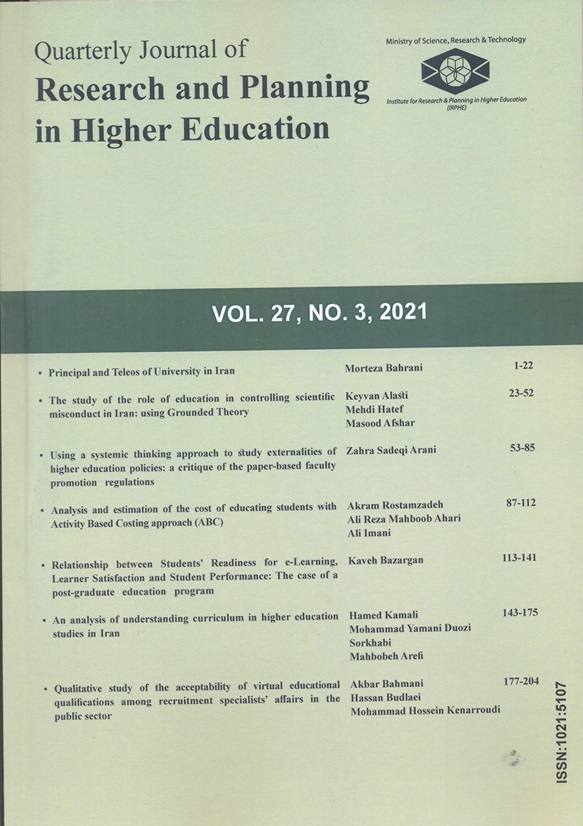
 Quarterly Journal of Research and Planning in Higher Education