1. Agolla, J.E., & Ongori, H. (2009). Paradigm shift in managing career plateau in organization: The best strategy to minimize employee intention to quit. African Journal of Business Management, 3(6), 268-271.
2. Azadi, R., & Eidi, H. (2016). The effects of job satisfaction and social capital on staff performance with the mediating role of organizational commitment (case study: the employees of the Ministry of Sport and Youth). Second Course, 8, 11-24(in Persian).
3. Bardwick, J.M. (1986). The plateauing trap. Toronto: Bantam Books.
4. Beheshtifar, M., & Modaber, H. (2013). The investigation of relation between occupational stress and career plateau. Interdisciplinary Journal of Contemporary Research in Business, 4(11), 650-660.
5. Burke, R. J., & Mikkelsen, A. (2006). Examining the career plateau among police officers. International Journal of Police Strategies and Management, 29(4), 691-703.
6. Choy, R. M., & Savery, L. K. (1998). Employee plateauing: Some workforce attitudes. Journal of Management Development, 17(6), 392-401.
7. Clark, J. W. (2004). Marketing management implications of career plateauing. Problems and Perspectives in Management, 4, 201-205.
8. Conner, D. (2014). The effects of career plateaued workers on in-group members’ perceptions of P-O fit. Employee Relations, 36(2), 198-212.
9. Denison, D. R., Haaland, S., & Goelzer, P. (2004), Corporate culture and organizational effectiveness: Is Asia different from the rest of the world?. Organizational Dynamics, 33(1), 98-109.
10. Fayyazi, M., & Ziyaee, S. (2014). The effects of career plateau on burnout and intention to quit job among librarians. Change Management Quarterly, 6(11), 73-91(in Persian).
11. Fayyazi, M. (2013). The effect of career plateauing on emotional commitment and career attachment (case study: Iranian university librarians). Iranian Management Sciences Quarterly, 32,139-156 (in Persian).
12. Godsholk, V. (2014). External and internal reasons for career plateauing. Group and Organization Management, 13.
13. Alvani, M., & Me’marzadeh, M. (2009). Organizational behavior (14th Ed.). p. 186, Tehran: Morvarid Publications (in Persian).
14. Jarvenpaa, S. & Staples, D. (2000). The use of collaborative electronic media for information sharing: an exploratory study of determinants. The Journal of Strategic Information Systems, 9(2-3), 129-154.
15. Jung, J., & Tak, J. (2008). The effects of perceived career plateau on employees’ attitudes moderating effects of career motivation and perceived supervisor support with Korean employees. Journal of Career Development, 35(2), 187-201.
16. Keshavarz Afshar, H., Anisi, J., Maleki, M., & Raesi, F. (2014). The relationship between demographic variables and job motivation alongside job burnout among faculty Members University. Journal of Behavioral Sciences, 8(2), 165-170(in Persian).
17. Khanifar, H. (2006). An investigation into the psychological aspects of career plateauing and providing scientific solutions. Management Culture, 12, 83-111(in Persian).
18. Kidd, J.M. (2000). Emotion: An absent presence in career theory. Journal of Vocational Behavior, 5, 54.
19. Klehe, U., Zikic, J., Van Vianen, A.E.M., & De Pater, I.E. (2011). Career adaptability, turnover, and loyalty during organizational downsizing. Journal of Vocational Behavior, 79, 217-229.
20. Klein, F. (2000). Retrieved from http://www,bickmann.de/knowledge-base/artikel-wissensmanagement.htm, 2004-01-15.
21. Kreuter, E. (2004). Why career plateaus are healthy? P. 87. Retrieved from http://www.lucaonline.com/ cpajournal/ old.htm.
22. Lee, P. C. B. (2003). Going beyond career plateau: Using professional plateau to account for work outcomes. Journal Management Development, 22(6), 538-551.
23. Lentz, E. (2004). The link between the career plateau and mentoring addressing the empirical gap. (Unpublished thesis).University of South Florida.
24. Manetje, O., & Martines, N. (2009). The relationship between organizational culture and organizational commitment. Southern African Business Review, 13(1), 87-111
25. Panhans, T. (2004). Cultural Change: Auf dem Weg zu einer Kultur für cooperatives Lernen und Arbeiten. Zeitschrift Wissens management, (2004), 1/04.
26. Riley, M., Lockwood, A., Powell-Perry, J., & Baker, M. (1998). Job satisfaction, organization commitment and occupational culture: a case from the UK pub industry. Progress in Tourism and Hospitality Research, 4(2), 159-168.
27. Rotondo, D., & Perewe, P. L. (2000). Coping with a career plateau: an empirical examination of what works and what doesn’t. Journal of Applied Social Psychology, 30, 2622-2646.
28. Salami, S. O. (2010). Career plateauing and work attitudes: Moderating effects of mentoring with Nigerian employees. The Journal of International Social Research, 3(11), 499-508.
29. Saleh Ardestani, A., & Seyed Naghavi, M.R. (2016). Study of the relationship between career plateauing, organizational indifference and employees’ tendency to quit jobs. Management Researches, 9(31), 145-160(in Persian).
30. Sand Holtz, K. (2003). Are you in danger of plateauing? P. 220. Retrieved from http:// www.happycareer. Com/ htmal/ are – you- in- dangerof plateauing.asp.
31. Schain, E., (1992). Organizational culture and leadership. San Francisco: Jossey Bass.
32. Shafaghat, A., Aghajani Afrouzi, A.A, & Nazok Tabar, H. (2012). Modeling the impact of the Factors of organizational culture on job satisfaction among the employees of the oil company; case study of national company of distribution of petroleum products in Mazandaran province. Behbood Modiriat, 6 (2), 41-57(in Persian).
33. Tabarsa, G.A., Rezaeian, A., Hadizadeh Moghaddam, A., & Jamali Nazari, A. (2014). Design and define job frostbite management model plateau in Iranian organizations (case study: Ministry of Industry, Mine and Trade). The Management of Governmental Organization Quarterly, 3(1), pp.90-103(in Persian).
34. Tepeci, M., & Bartlett, A. L. B. (2002). The hospitality industry culture profile: a measure of individual values, organizational culture, and person-organization fit as predictors of job satisfaction and behavioral intentions. Hospitality Management, 21(2), 151-170.
35. Tremblay, M., Roger, A., & Toulouse, J. M. (1995). Career plateau and work attitudes: An empirical study of managers. Human Relations, 48, 221-237.
36. Vahedi, M., Bashir Naem, Y., & Rasouli, M. (2014). An investigation of the effects of job characteristics on career plateau during job development of human resources. Quarterly Research Journal of Management Studies (Improvement and Change), 22, 25-62(in Persian).
37. Yamamoto, H. (2006). The relationship between employees' inter organizational career orientation and their career strategies. Career Development Journal, 11(3), 243-264.
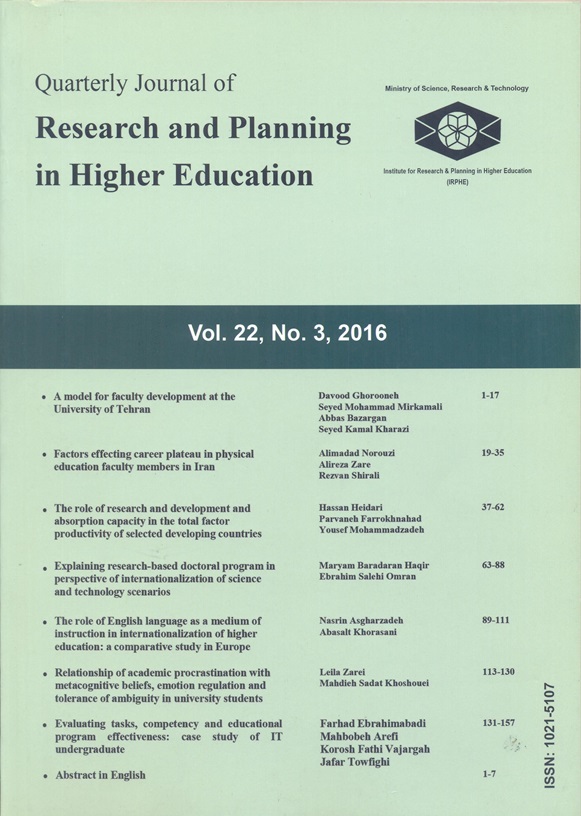
 Quarterly Journal of Research and Planning in Higher Education