1. Abu-Shanab, E. (2014). E-learning system's acceptance: A comparative study. International Journal of Web-Based Learning and Teaching Technologies, 9(4), 1-13.
2. Adams, J., Defleur, M., & Heald, G. (2007). The Acceptability of Credentials Earned Online for Obtaining Employment in the Health Care Professions.
3. Applegate, C. (2020). E-learning Acceptance: Online Teaching Degree Earners and What Principals Think, Health and Academic Achievement. Online First, DOI: 10.5772/intechopen.95237.
4. Boudlaie, H., & Kenarroodi, M. (2020). A qualitative study of gamification-based recruitment process in start ups. Management Studies in Development and Evolution, 29(96), 121-148. DOI: 10.22054/jmsd.2020.47159.3434 [in Persian].
5. Elfaki, N., Ahmad, I., & Abdelrahim, R. (2019). Impact of e-learning vs traditional learning on students' performance and attitude. International Medical Journal, 1994, 24, 225-233.
6. Ali, W. (2020). Online and remote learning in higher education institutes: A necessity in light of COVID-19 pandemic. Higher Education Studies.
7. Allen, I., & Seaman, J. (2013). Changing Course: Ten Years of Tracking Online Education in the United States.
8. Bigné, E., Badenes, A., Ruiz, C., & Andreu, L. (2018). Virtual cclassroom: Teacher skills to promote student engagement. Journal of Management and Business Education, 1, 87-105.
9. Brown, B.L. (2000). Web-based Training. Washington D.C.: Office of Educational Research and Improvements. Report No: EDO- CE - 00-248p.
10. Chaney, E.G. (2002). Pharmaceutical employers’ perceptions of employees or applicants with e-degrees or online coursework (Doctoral dissertation). Retrieved from Proquest Dissertations and Theses database. (UMI Order No. 3061561).
11. Darabi, S., Neyestani, M.R., & Babri, H. (2014). Identification and prioritization of the strategic planning components in virtual learning (A qualitative study in the virtual faculty of Isfahan University). Interdisciplinary Journal of Virtual Learning in Medical Sciences (IJVLMS), 5(3), [in Persian].
12. Erdos, R. (1967). Teaching by correspondence. London, UK: Longmans, Green & Co Limited.
13. Faraj Elahi, M., & Zarif Sanaei, N. (2009). Information and communication technology based education in higher education. (Unpublished master's thesi). Shiraz University of Medical Sciences [in Persian].
14. Güttel, W., Hermann, F., & Kessler, A. (2017). Environmental dynamism, hostility, and dynamic capabilities in medium-sized enterprises. International Journal of Entrepreneurship and Innovation, 18.
15. Mäenpää, K. (2020). Online degree education through cross studies.
16. Matthews, D. (1999). The origins of distance education and its use in the United States. T.H.E. Journal, 27(2).
17. Montazer, GH.A. (2005). A Query on virtual university and e-learning. Peyke Noor Journal, 3(2), 107-110 [in Persian].
18. Maykut, P., & Morehouse, R. (1994). Beginning Qualitative Research: A Philosophic and Practical Guide. Falmer Press/Taylor & Francis, Inc.
19. Ngampornchai, A., & Adams, J. (2016). Students’ acceptance and readiness for e-learning in Northeastern Thailand. International Journal of Educational Technology in Higher Education, 13(34), 1-13.
20. Palvia, S., Aeron, P., Gupta, P., Mahapatra, D., Parida, R., Rosner, R., & Sindhi, S. (2018). Online education: Worldwide status, challenges, trends, and implications. Journal of Global Information Technology Management, 21(4), 233-241.
21. Ponnampalam, P., Kariapper, A., Razeeth, S., Nafrees, A.C.M., Rishan, U., & Ali, S. (2019). E-learning at Home Vs Traditional Learning among Higher Education Sstudents: A Survey based Analysis.
22. Sabouri, S., & Ali Marzdanzadeh, M. (2020). The effect of face-to-face and virtual education methods on the score of Kerman pharmacy students. Iranian Journal of Medical Education, 20 (83), 35.
23. Saeed, N., Zare, H., Moosapour, N., Sarmadi, M., & Hormozi, M. (2011). The study of relationship between students’ cognitive and Meta-cognitive strategies and interactions in virtual education with academic achievement. Quarterly Journal of Research and Planning in Higher EducationI, 16 (4), 73-96 [in Persian].
24. Shahbeigi, F., & Nazari, S. (2012). Virtual education: Benefits and limitations. Jmed, 6 (1), 47-54 [in Persian].
25. Shafiei Sarvestani, M., Mohammadi, M., Afshin, J., & Raeisy, L. (2019). Students’ experiences of e-learning challenges; a phenomenological study. Interdisciplinary Journal of Virtual Learning in Medical Sciences, 10(3), 1-10.
26. Tafakheri, M. (2005). Study of the characteristics of virtual universities in Iran. (Unpublished Master Thesis). Islamic Azad University, Sari Branch [in Persian].
27. Watson, C. (2016). Acceptance of online education degrees by human resource recruitmers. A dissertation submitted in partial fulfillment of the requirements for the degree of Doctor of business administration. self discipline.
28. Yang, Z., & Liu, Q. (2005). Research and development of web-based virtual online classroom. Computers and Education, 17, 68-73.
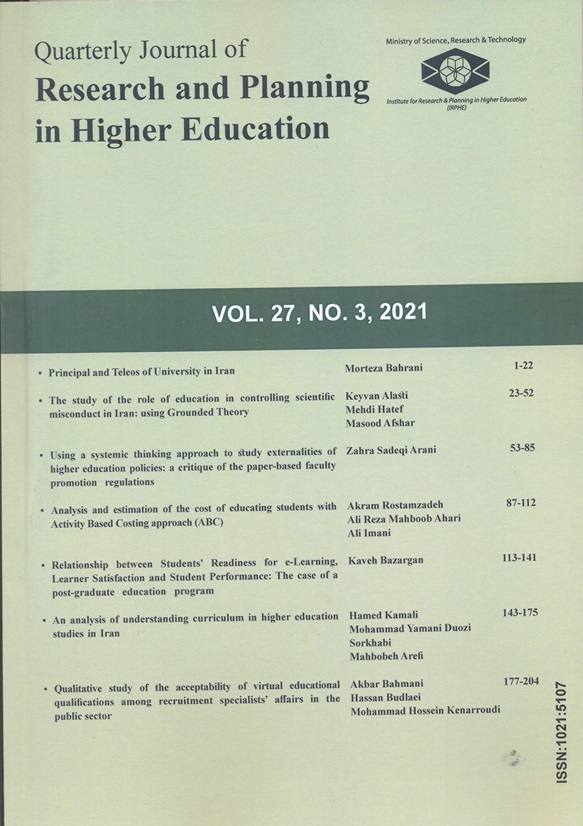
 Quarterly Journal of Research and Planning in Higher Education