1. Abazari, Y. (2015). The isolation of sociology. Farhangemrooz Website, Accessed May 2, 2015, Retrieved from http://farhangemrooz.com/news/ 31972 (in Persian).
2. Abdolahiyan, H., & Azad Armaki, T. (2015). The critical analysis of the books on the basics of sociology in Iran. Journal of Research and Writing University Books, (36), 1-27 (in Persian).
3. Alikhah, F. (2017). Presence in the community, liberation from desktop sociology. Lecture in the Culture and Society Group of the Iranian Sociological Association, Accessed December 4, 2017, Retrieved from www.isa.org.ir (in Persian).
4. Amin Mozafari, F., & Yusefi Aghdam, R. (2011). The impact of discipline culture on socialization tactics of doctoral students. Quarterly Journal of Research and Planning in Higher Education, 62, 47-63 (in Persian).
5. Azad Armaki, T. (1999). The sociology of sociology in Iran. Tehran: Kaleme (in Persian).
6. Azad Armaki, T. (2008). Educating sociology in Iran: Challenges and opportunities. Journal of Iranian Higher Education, 1(1). Summer (in Persian).
7. Burawoy, M. (2008). For public sociology. Translated by Nazanin Shah Rokni, Iranian Journal of Sociology, 8(1), 168-201 (in Persian).
8. Calhoun, C. (2010). Social sciences in North America. In World Social Science Report: Knowledge Divides, pp. 55-58, International Social Science Council, Paris: UNESCO Publishing. Retrieved from https://unesdoc.unesco.org/ark:/48223/pf0000188333
9. Clark, B.R (1998). Creating enterprenneurial universities: Organisational pathways of transformation. Oxford: Elsevier.
10. Delanty, G. (2007). Challenging knowledge: The University in the Knowledge Society. Translated by Ali Bakhtiyari Zadeh, Tehran: Research Institute of Cultural and Social Studies (in Persian).
11. Delanty, G. (2001). Challenging knowledge: The University in the Knowledge Society. The Society for Research in to Higher Education & Open University Press.
12. Ejlali, P. (2007). Reconstruction and development of social sciences with a glance at the curriculum structure. Tehran: Research Institute of Cultural and Social Studies (in Persian).
13. Ericson, R. (2005). Publicizing sociology. The British Journal of Sociology, 56(3).
14. Farasatkhah, M., & Asghar Zadeh, N. (2018). History of the university in Iran. Tehran: Research Institute of Cultural and Social Studies (in Persian).
15. Farasatkhah, M. (2009). University and higher education; Global perspectives and Iranian issues. Tehran: Ney (in Persion).
16. Farasatkhah, M. (2010 a). A survey of interactions between higher education and other systems of production and services. Quarterly Journal of Research and Planning in Higher Education, 16(3), 45-64 (in Persion).
17. Farasatkhah, M. (2010 b) Sociology of social science education in Iran after the Islamic Revolution. Summary of Social Sciences Conference Papers in Iran; Achievements and Challenges, Iranian Sociological Association, Tehran: May 19-20 (in Persion).
18. Farasatkhah, M. (2016). Qualitative research method in social sciences with emphasis on "theory based" (Grounded Theory of GTM). Tehran: Agah (in Persian).
19. Farasatkhah, M. (2017). Occasionality of university in Iran; new and critical discussions on university research, science studies, and higher education. Tehran: Agah (in Persian).
20. Fazeli, M. (2015). Death, the prolonged life of academy: The pathology of lethargy of social sciences in the Iranian academy. Journal of Andisheh Pouyam, No. 29 (in Persion).
21. Fazeli, M., Fatahi, S., & Eshtiyaghi, M. (2014). Sociology audit. Tehran: The Secretariat of the Audit the Humanities Development (in Persian).
22. Fazeli, M. (2007). The inefficiency of sociology in Iran: A review of the literature. The Growth of Social Science Education, 11(2), 21-30 (in Persion).
23. Fazeli, N. (2008) Culture and university (Anthropological Perspectives and Cultural Studies). Tehran: Sales (un Persion).
24. Fazeli, N. (2010). Learning and teaching challenges in social sciences. Summary of Social Sciences Conference Papers in Iran; Achievements and Challenges, Iranian Sociological Association, Tehran: May 19-20 (in Persion).
25. Ghanei Rad, M.A., & Ebrahin Abadi, H. (2010). The effect of social structure of education on student performance. Quarterly Journal of the Iranian Higher Education Association, (4), spring (in Persion).
26. Ghanei Rad, M.A., Maleki, A., & Mohammadi, Z. (2014). The study of cultural transformation in three generations of academics (Case study: Professors of social sciences, Universities of Tehran). Journal of Iranian Journal of Sociology, 14(1), 30-64 (in Persian).
27. Ghanei Rad, M.A. (2006 a). The status of the scientific society in social sciences. Journal of Social Science Letter, (27), spring (in Persian).
28. Ghanei Rad, M.A. (2006 b). The role of student-professor interaction in the development of academic social capital. Journal of Iranian Journal of Sociology, 7(1), 3-29 (in Persian).
29. Ghanei Rad, M.A. (2006 c). Student interactions, motivation and disciplinary activism. Quarterly Journal of Research and Planning in Higher Education, 12(2), 1-22 (in Persian).
30. Ghanei Rad, M.A. (2006 d). Interactions and communication in the academic community. Tehran: Research Institute of Cultural and Social Studies (in Persian).
31. Ghanei Rad, M.A. (2010). Political and social participation of elites. Commissioned by the Secretariat of the Supreme Council of the Cultural Revolution: Social Council. Tehran: Rahdan (in Persian).
32. Ghanei Rad, M.A. (2013). Higher education amidst new conflicts between new occupationalism and civil and democratic professionalism. Quarterly Journal of the Iranian Higher Education Association, 6(1), winter (in Persion).
33. Harding, S. (2010). Standpoint methodologies and epistemologies: A logic of scientific inquiry for people. In World Social Science Report: Knowledge Divides, pp. 173-175, International Social Science Council, Paris: UNESCO Publishing.
34. Kalleberg, R. (2000). The most important task of sociology is to strengthen and defend rationality in public discourse. The Sociology of Vilhem Aubert, Acta Sociologica, 43 (4), 399-411.
35. Kalleberg, R. (2005). What in public sociology? Why and how should it be made stronger?. The British Journal of Sociology, 56(3).
36. Kazemi, A. (2017). A narrative of university classes; the lived experience of university professors. Tehran: Research Institute of Cultural and Social Studies (in Persian).
37. Kazemi, A. (2018). University: Ffrom ladder to shade. Tehran: Research Institute of Cultural and Social Studies (in Persian).
38. Kerr, K. (2001). The use of the university. Cambridge, MA: Harvard University Press, 5thed.
39. Lyotard, J.F. (2001). Postmodern condition: A report on knowledge. Translated by Hossein Ali Nozari, Tehran: Gam-e-No (in Persian).
40. Martinelli, A. (2010). Social science in the public space. In World Social Science Report: Knowledge Divides, pp. 287-289, International Social Science Council, Paris: UNESCO Publishing.
41. Mohadesi Gilvaei, H. (2018). University story; sociology of scientific and academic organizations. Tehran: Research Institute of Cultural and Social Studies (in Persian).
42. Mohammadi, Z., & Ghanei Rad, M.A. (2014). The typology of social sciences professors in the post-university period. Journal of Cultural and Social Development, 1(1), 78-91 (in Persian).
43. Mohseni Tabrizi, A.R. (2011). Content analysis of sociology books taught in universities. World Journal of Media, 6(2), 75-105 (in Persian).
44. Nowotny, H., Scott, P.B., & Gibbons, M.T. (2010). Re-thinking science, knowledge and the public in an age of uncertainty. Cambridge: Polity Press.
45. Rashidi, Z. (2017). Conceptualization of global citizenship according to Iranian higher education experts' point of views: A grounded theory approach. Quarterly Journal of Research and Planning in Higher Education, 23 (2), 93-114 (in Persian).
46. Readings, B. (1996). The university in ruins. Cambridge, MA: Harvard University.
47. Seraj Zadeh, S.H., & Javaheri, F. (2015). The project of measurement of attitudes, values, and behaviors of students in Iran. Tehran: Research Institute of Cultural and Social Studies (in Persian).
48. Share Poor, M., & Fazeli, M. (2010). The education of sociology and sociological imagination. Encyclopedia of Social Sciences, 1(3), spring (in Persian).
49. Share Poor, M., & Soleymani Beshli, M.R. (2011). Challenges facing the teaching of social sciences in Iran. Sociology of Education, (1), 131-157 (in Persian).
50. Tarschys, D., & Lachapelle, G. (2010). Social scientists in the corridors the analysis of the social sciences and humanities literature. In World Social Science Report: Knowledge Divides, pp. 293-295, International social Science Council, Paris: UNESCO Publishing.
51. Yusefi Aghdam, R. (2015). The temporary fact and developing the theory of doctoral student professional identity in Iran. Quarterly Journal of Science and Technology Policy, 7(2), summer (in Persian).
52. Zaki, M.A. (2013). Teaching sociology and women's critical thinking. Applied Sociology, 51(3), autumn (in Persian).
53. Zokaei, M.S., & Esmaeili, M J. (2014). Youth and academic alienation. Tehran: Research Institute of Cultural and Social Studies (in Persian).
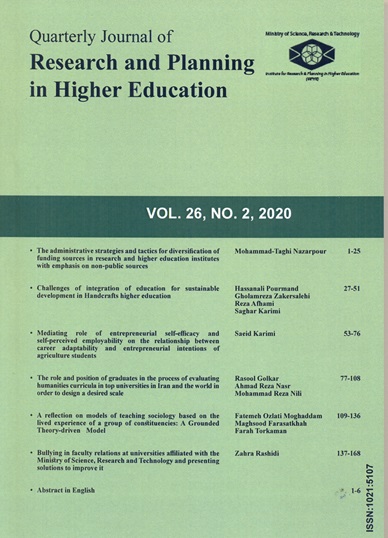
 Quarterly Journal of Research and Planning in Higher Education