1. Al Agha, F., Keshavarz, M., & Rahimi, M. (2009). The quantitative growth process of private and public higher education in the Islamic Republic of Iran. Journal of Research in Curriculum, 20, 73-110 (in Persian).
2. Corrupted Hands (2015). A report on plagiarism in academic society in Iran. Farhang-eh Emroz, N0. 3 (in Persian).
3. Ganji, N., (2014). How much do you write a dissertation? A report from seeling and buying theses in Tehran Bazar. Tejarat-e-Farda Weekly, Retrieved from link https://b2n.ir/884838. (in Persian).
4. Ghaedi, M., Safaei-ghadikolaei, A., Rezeghi, N., & Madhoshi, M. (2018). Causes and context of academic corruption and its consequences. Quarterly Journal of Higher Education Management, 24(1), 113-135 (in Persian).
5. Jalalvand, A. (2015). Selling dissertation from hidden crime to job. Jameh-Jam New agency, Retrieved from jjo.ir/AhHcGy (in Persian).
6. Jafarian, R. (2014). what we can do with dissertations problem? Release Date December 2014, Retrieved from https://b2n.ir/919135) .in Persian)
7. Ojaghi, R., Keyvanara Cheshmeh, M., & Sohrabi, A. (2012). Pathology analysis of plagiarism: A qualitative research, Iranian Journal of Medical Education, 11(9), 1063 - 1073 (in Persian).
8. Kazemian, A. (2017). Academic misconduct in carrying out an academic project: A study among the sixth-year students of Mashhad Dental School. The Journal of Mashhad Dental School, 41, 372-295. (in Persian).
9. Shahghasemi, E., & Akhavan, M. (2015). Confessions of academic Ghost Authors: The Iranian experience. SAGE Open January, 1-7 (in Persian).
10. Varij Kazemi, A., & Dehqhan Dehnavi, A. (2017). The new academic proletariat in Iran. Critique, 45(1-2), 141-158 (in Persian).
11. Varij Kazemi, A. (2018). University; From Ladder to canopy. Tehran: Cultural and Social Studies Institute publication. Tehran, Iran (in Persian).
12. Zare, R. (2016). Dissertations; a doping problem. Young Journalist Club, Retrieved from newshub.ir/news/56578877. (in Persian).
13. Zariei, F. (2014). The high costs of a major scientific fraud, the story of elite ghost writer, Mehr New Agency, Retrieved from mehrnews.com/news/2350568. (in Persian)
14. Aghajanzadeh, H., & Rezaee, M. (2015). Conjuncture analysis, a step beyond the dualism of theory / methodology in cultural studies. Historical Sociology, 3.
15. Fazeli, M., & Zahedi, M. M. (2016) The challenges of theses writing in Iran; Why theses buy and sell in Iran? Zavieh TV Program. Retrieved from https://b2n.ir/981401. (in Persian).
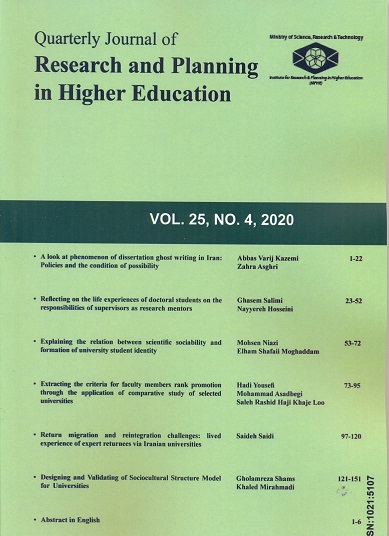
 Quarterly Journal of Research and Planning in Higher Education