1. AGB (2007). AGB statement on board accountability. Retrieved from http://agb.org/sites/agb.org/files/u3/AccountabilityStatement2007.pdf.
2. Azargashb, E., Arasteh, H., Sabaghian, Z., & Towfighi, J. (2007). An evaluation of boards of trustees functions in public universities affiliated to ministry of science, research, and technology (1991-2006). QuarterlyJournal of Research & Planning in Higher Education, (46), 1-20 (in Persian).
3. Bastedo, M. (2009). Conflicst, commitments, and cliques in the university: Moral seducation as a threat to trustee independence. American Educational Research Journal, 46(2), 354-386.
4. Blau, P.M. (1973). The organization of academic work. New York: Wiley.
5. Blau, P.M. (1974). On the nature of organizations. New York: Wiley.
6. Birnbaum, R. (2003). How colleges work: The cybernetics of academic organization and leadership. Translated by Arasteh, H.R. Tehran: Institute of Research & Planning for Higher Education, 5-6 (in Persian).
7. Bowen, W.G. (2008). The board book: An insider’s guide for directors and trustees. New York: Norton.
8. Campbell, M. (2002). Governance structures: Academic senate and trustee boards. Retrieved from http://www.asstudent.unco. edu/students/ae-extra, P. 2.
9. Duryea, E.D., & Williams, D. (2000). The academic corporation: A history of college and university governing boards. New York: Falmer Press. Jossey-Bass.
10. Gadd, M. L. (1997). Boards of trustees. Translated by: Nafisi, N., in: Higher Education Encyclopedia. Tehran: Institute of Research & Planning for Higher Education, P. 707 (in Persian).
11. Hendrickson, R.M., Lane, J.E., Harris, J.T., & Dorman, R.H. (2013). Academic leadership and governance of higher education. USA, Stylus Publishing.
12. Hofstadter, R. (1955). Academic freedom in the age of the college. New York, NY: Columbia University Press.
13. Kaskeh, S., & Mohebzadegan, Y. (2011). Strategic development of universities explanation of functional elements of board of trustees and trend analysis of function. Social Development and Welfare Planning, 2, 165-202 (in Persian).
14. Kezar, A.J. (2006). Rethinking public higher education governing boards performance: Results of a national study of governing boards in the United States. J. of Higher Education, 77(6), 968-1008. doi:10.1353/jhe.2006.0051.
15. MacTaggart, T. (2011). Leading change: How boards and presidents build exceptional academic institutions. Washington, DC: AGB Press.
16. Novak, R., & Johnston, S.W. (2005). Trusteeship and the public good. In A. Kezar, T. C.
17. Nason, J.W. (1980). Responsibilities of the governing board. In R. T. Ingram (Ed.), Handbook of college and university trusteeship (pp. 27-46). Hoboken, NJ: Jossey- Bass.
18. Sajjadi, H.S., Maleki, M.R., Hadi, M., & Hasanzadeh, H.R. (2014). Design of model for evaluation of boards of trustees in Universities of Medical Sciences. Iranian Higher Education Journal, 6(2), 138-170 (in Persian).
19. Schein, E. (1983). Organizational psychology. New Delhi, Prentice Hall.
20. Strauss, A.L. & Corbin, J. (2008). Basics of qualitative research. Translated by Mohammadi, B., Tehran: Human Science & Cultural Studies Center Publication. (in Persian).
21. Washington State University (2006). Board of regents: General powers & duties. Retrieved from http://www.regents.wsu.edu. /generalpowers. html, P. 1.
22. Wilson, E.B. (2005). It all boils down to this. Trusteeship, 13(5), 8-12.
23. Wilson, E.B. (2007). Row, row, row the same boat. Trusteeship, 15(3), 8-13.
24. Zwingle, J.L. (1980). Evolution of lay governing boards. In R. T. Ingram (Ed.). Handbook of college and university trusteeship (pp. 14-26). San Francisco, CA: Jossey-Bass.
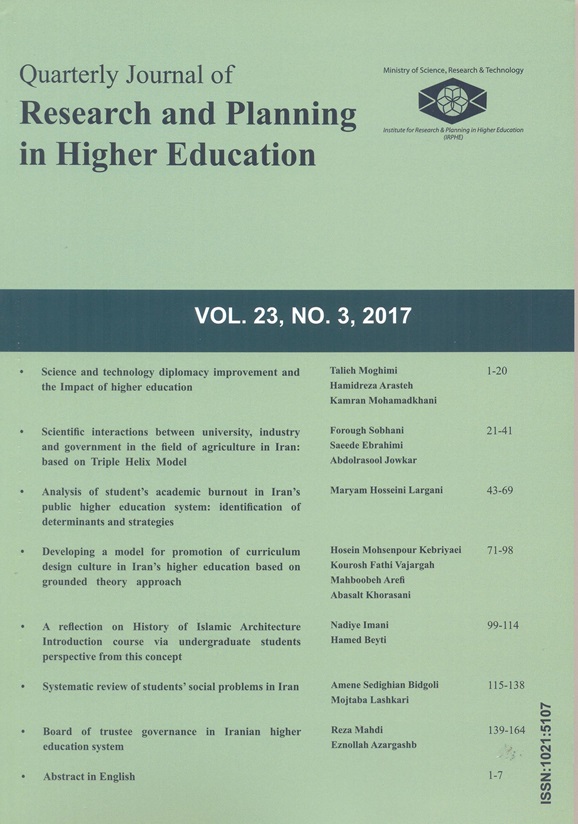
 Quarterly Journal of Research and Planning in Higher Education