1. Azizi, M. (1392). The study of entrepreneurship development and entrepreneurship fields in undergraduate and postgraduate students of Shahid Beheshti University. (Master's thesis). Faculty of Education and Psychology, Shahid Beheshti University (in Persian).
2. Boroumand Nasab, M. (2002). A review of the simple and multiple relationships between creativity, the motivation of progress and self-esteem with entrepreneurship in students at Shahid Chamran University of Ahvaz. (Ph. D thesis). Department of Education and Psychology (in Persian).
3. Burch, J. (1986). Profiling the entrepreneur. Business Horizons, 13-16.
4. Ching, Y.S., & Chann, L. (2012). The relationship among creative, critical thinking and thinking style in Taiwan ltinght School Students. Journal of Instructional Psychology, 31.
5. Drucker, P. (1985), Innovation and entrepreneurship. NY: Harper Collins Publisher.
6. Emamipour, S., & Seif, A.A. (2009). A study on the development of thinking styles in students and their relationship with creativity and academic Achievement. Quarterly of Educational Innovations, 25(21), 30-35 (in Persian).
7. Grigorenko, E.L., & Sternberg, R.J. (2010). Styles of thinking. abilities and academic performance. Exceptional Children.
8. Hezarjaribi, J. (2011). The study of the entrepreneurship of graduates of the humanities in the fields of social and cultural publications in Tehran. (Ph.D. thesis). Department of Literature and Humanities, Isfahan University (in Persian).
9. Javaheri, F. (2013). Obstacles to women's entrepreneurship: The impact of gender inequality on women's entrepreneurship in Iran. Journal of Sociology of Iran, 5(2), 13-23 (in Persian).
10. Keras, K. (2010). From Sternberg, a new take on what makes kids Tufts - worthy. Tufts Daily, November.
11. Kuratko, D., & Montagno, R. (1989). The entrepreneurial spirit. Training and Development Journal. 43 (10), 83-87.
12. Lumbe, J. (2012). Thinking styles and accessing information on the world wide web. Bangor, University College of North Wales.
13. Moghimi, S.M. (2004). Creativity in civil society institutions. Tehran: Tehran University Press (in Persian).
14. Postigo, S. (2012). Entrepreneurship education in Argentina: The case of Sananders University. In Proceedings of the Conference Entitled, The Internationalizing in Entrepreneurship Education and Training, Malyasia.
15. Samad Aghaei, J. (2004) Creativity: Essence of entrepreneurship. Tehran: University of Tehran. Tehran University Entrepreneurship Center (in Persian).
16. Shaver, K.G., Willams, S.I., & Scott, L.R. (2009). Entrepreneurial beliefs. Creativity and risk-taking: Personality or situation. Unpublished Manuscript, College of William and Mary.
17. Shokri, O., Kadivar, P., Farzad, V., & Daneshvarpour, V. (2008). The relationship between thinking styles and learning approaches with students' academic achievement. Quarterly Journal of New Cognitive Science, 30(2), 35-48 (in Persian).
18. Sternberg, R. J., & Lobart, R.K. (2005) Thinking styles inventory. Yale University Unpublished Test.
19. Sternberg, R.J. (2003). A three facet model of creativity in R.J. Sternberg (ED). The Nature of Creativity Cambridge: Cambridge University Press.
20. Zhang. L.F. (2014). Thinking styles and big five personality traits revisited. Journal Elsevier Personality and Individual Difference, 40.
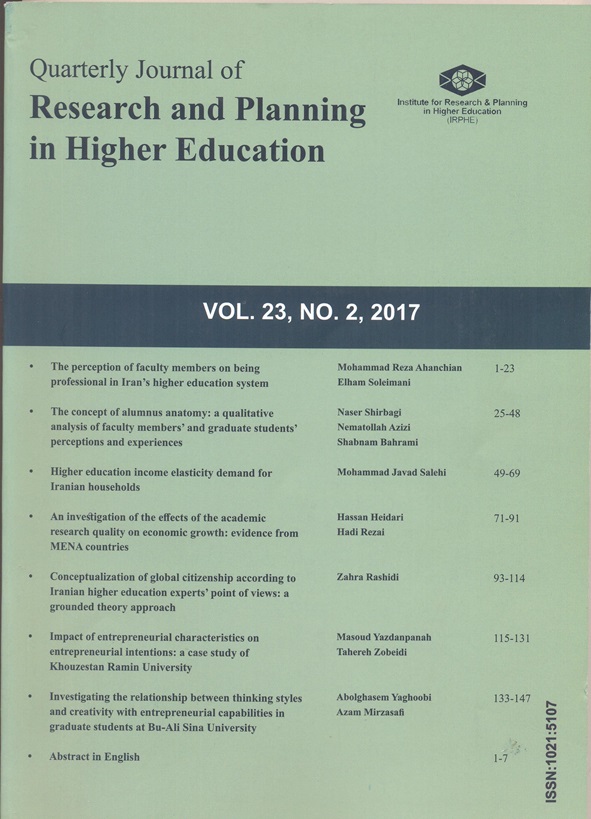
 Quarterly Journal of Research and Planning in Higher Education