1. 17Uusitalo, R. (2001). Homo entrepreneurs? Applied Economics, 33(13), 1631-1638.
2. Agricultural and Natural Resources Engineering Organization (2014). Unemployment rate is 25 percent of graduates. Retrieved from http://iaeo.org/p=4038(in Persian).
3. Ajzen, I. (1991). The theory of planned behavior. Organizational Behavior and Human Decision Processes, 50(2), 179-211.
4. Akhter, R., & Sumi, F. R. (2014). Socio-cultural factors influencing entrepreneurial activities: A study on Bangladesh.
5. Ansari, M. T., & Salmanizade, A. (2008). Demographic characteristics of Iranian entrepreneurs. Social Welfare, 7 (29), 167-188. Retrieved from http://refahj.uswr.ac.ir/article-1-2096-fa.html(in Persian).
6. Autio, E., Keeley, R. H., Klofsten, M., Parker, G. G. C., & Hay, M. (2001). Entrepreneurial intent among students in Scandinavia and in the USA. Enterprise and Innovation Management Studies, 2(2), 145-160.
7. Bandura, A. (1997). Self-efficacy: The exercise of control. New York: Freeman.
8. Baron, R. A. (2004). The cognitive perspective: A valuable tool for answering entrepreneurship’s basic “why” questions. Journal of Business Venturing, 19(2), 221-239.
9. Baron, R. A. (2007). Entrepreneurship: A process perspective. In J. R. Baum, M. Frese, & R. A. Baron (Eds.). The psychology of entrepreneurship (pp. 19-40). Mahwah, London: Lawrence Erlbaum.
10. Baron, R. A., & Markman, G. D. (2003). Beyond social capital: The role of entrepreneurs' social competence in their financial success. Journal of Business Venturing, 18(1), 41-60.
11. Batjargal, B. )2010(. Network dynamics and new ventures in China: A longitudinal study. Entrepreneurship & Regional Development, 22(2), 139-53.
12. Baumeister, R. F., Campbell, J. D., Krueger, J. I., & Vohs, K. D. (2003). Does high self-esteem cause better performance, interpersonal success, happiness, or healthier lifestyles? Psychological Science in the Public Interest, 4, 1-44.
13. Bird, B. (1988). Implementing entrepreneurial ideas: The case of intentions. Academy of Management Review, 13 (3), 442-454.
14. Brockhaus, R. (1994, September). Family business: A blessing or a curse? Keynote Address, Proceedings of the Small Enterprise Association of Australia and New Zealand Conference, Auckland: NZ, 25-27 September.
15. Campbell, J. D., & Lavallee, L. F. (1993). Who am I? The role of self-concept confusion in understanding the behavior of people with low self-esteem. In R. F. Baumeister (Ed.). Self-esteem. The puzzle of low self-regard (pp. 3–20). New York: Plenum Press.
16. Cope, J., Jack, S., & Rose, M.B. (2007). Social capital and entrepreneurship an introduction. International Small Business Journal, 25(3), 213-219.
17. Evald, M.R., Klyver, K., & Svendsen, S.G. (2006). The changing importance of the strength of ties throughout the entrepreneurial process. Journal of Enterprising Culture, 14(1), 1-26.
18. Fayolle, A., & DeGeorge, J.M. (2006). Attitudes, intentions, and behavior: New approaches to evaluating entrepreneurship education. In A. Fayolle & H. Klandt (Eds.). International entrepreneurship education. Issues and newness (pp. 74-89). Cheltenham: Edward Elgar.
19. Forbes, D.P. (2005). Are some entrepreneurs more overconfident than others? Ournal of Business Venturing, 20(5), 623-640.
20. Forret, M. L., & Dougherty, T. W. (2004). Networking behaviors and career outcomes: Differences for men and women?. Journal of Organizational Behavior, 25(3), 419-437.
21. Frese, M. (2009). Toward a psychology of entrepreneurship-an action theory perspective. Foundations and Trends in Entrepreneurship, 5, 437- 496.
22. Fry, F.L. (1993). Entrepreneurship: A Planning Approach. West Publishing Company.
23. Ghasemi, J., Asadi, A., & Hoseininia, GH. (2009). Investigating factors affecting entrepreneurial mentality of Tehran University’s graduate students. Iranian Journal of Agricultural Economics and Development Research, 40(2), August (in Persian).
24. Hajimirrahimi, S., & Noruzi, D. (2015). Study of the student's entrepreneurial competencies at agricultural applied-science courses; A case study of the Imam Khomeini higher education center, IHEC. Iran Agricultural Extension and Education Journal, 10(2), 67-90 (in Persian).
25. Hosseini, S. M., Kalantari, K., & Eskandari, F. (2008). The role of Iranian higher education system on entrepreneurial success of its graduates: Some policy implications for entrepreneurship education. American Eurasian Journal, 3(3), 394-402.
26. Kernis, M.H. (2003). Toward a conceptualization of optimal self-esteem. Psychological Inquiry, 14, 1-26.
27. Klyver, K., & Foley, D. (2012). Networking and culture in entrepreneurship. Entrepreneurship & Regional Development, 24(7-8), 561-588.
28. Krueger, N. F. (2003). The cognitive psychology of entrepreneurship. In Z. J. Acs & D. B. Audretsch (Eds.). Handbook of entrepreneurship research: An interdisciplinary survey and introduction (pp. 105–140), London: Kluwer.
29. Krueger, N., Reilly, M., & Carsrud, A. (2000). Competing models of entrepreneurial intentions. Journal of Business Venturing, 15, 411-432.
30. Laguna, M. (2013). Self‐efficacy, self‐esteem, and entrepreneurship among the unemployed. Journal of Applied Social Psychology, 43(2), 253-262.
31. Liñán, F., Rodríguez-Cohard, J. C., & Rueda-Cantuche, J. M. (2011). Factors affecting entrepreneurial intention levels: A role for education. International entrepreneurship and management Journal, 7(2), 195-218.
32. Macko, A., & Tyszka, T. (2009). Entrepreneurship and risk taking. Applied Psychology an International Review, 58, 469-487.
33. Markham, G., Balkin, D., & Baron, R. (2002). Inventors and new venture formation: The effects of general self-efficacy and regretful thinking. Entrepreneurship Theory and Practice, 27(2), 149-165.
34. Navehebrahim, A., & Tandiseh, A. (2009). Study of entrepreneurship indexes among students in the final year of the three branches of theoretical, technical, professional and Kardanesh (Garmsar city secondary schools). Quarterly Journal of Educational Leadership & Administration, 2(2),133-146(in Persian).
35. Neghabi, S., Zafarian, R., Yosefi., M., & Rezani, M. (2012). Determining the role of networking behavior in relation to entrepreneurial behavior. Journal of Entrepreneurship Development, 5(1), 25-43(in Persian).
36. Nemati, M.A. (2013). Investigating student’s entrepreneur personal characteristics in Tehran governmental universities. Quarterly Journal of Innovation and Entrepreneurship, 1(3), 47-64 (in Persian).
37. Pines, A. M., Dvir, D., & Sadeh, A. (2012). Dispositional antecedents, job correlates and performance outcomes of entrepreneur’s risk taking. International Journal of Entrepreneurship, 16, 95.
38. Rauch, A., & Frese, M. (2007). Let’s put the person back into entrepreneurship research: A meta-analysis on the relationship between business owners’ personality traits, business creation, and success. European Journal of Work and Organizational Psychology, 16(4), 353-385.
39. Safa, L., & Mangeli, N. (2015). The effect of entrepreneurial self-efficacy on agricultural students ‘entrepreneurial intention at University of Zanjan. Agricultural Education Administration Research, 7(33), 3-15(in Persian).
40. Schmidt, C. (2011). Factors influencing entrepreneurship. Retrieved from http://www.grin.com/en/e-book/204296/factors-influencing-entrepreneurship.
41. Segal, G., Borgia, D., & Schoenfeld, J. (2002). Using social cognitive career theory to predict self-employment goals. New England Journal of Entrepreneurship, 5(2), 47-56.
42. Shook, C. L., Priem, R. L., & McGee, J. E. (2003). Venture creation and the enterprising individual: A review and synthesis. Journal of Management, 29, 379-399.
43. Singh, R., Hills, G., Hybels, R., & Lumpkin, G. (1999). Opportunity recognition through social network characteristics of entrepreneurs. Frontiers of Entrepreneurship Research, 228-241.
44. Wagner, J., & Sternberg, R. (2004). Start-up activities, individual characteristics, and the regional milieu: lessons for entrepreneurship support policies from German micro data. Annals of Regional Science, 38 (2), 219-240.
45. Wang, C., Wong, P., & Lu, Q. (2002). Tertiary education and entrepreneurial intentions. In P. Phan (Ed.). Technological entrepreneurship (pp. 55–82). Greenwich, CT: Information Age Publishing.
46. Wilson, F., Kickul, J., & Marlino, D. (2007). Gender, entrepreneurial self‐efficacy, and entrepreneurial career intentions: Implications for entrepreneurship Education1. Entrepreneurship Theory and Practice, 31(3), 387-406.
47. Wolff, H., Moser, K., & Grau, A. (2008). Networking: Theoretical foundations and construct validity. Readings in applied organizational behavior from the Luneburg Symposium.
48. Yazdanpanah, M., Khosravipuor, B., Mohammadi, Z., & Dehghanpour, M. (2016). Studying of intention of undergraduate's student of Khuzestan Ramin University of Agriculture and Natural Resources toward entrepreneurship. Journal of Entrepreneurship in Agriculture. 3(2), 77-90 (in Persian).
49. Zhao, X., Frese, M., & Giardini, A. (2010). Business owners’ network size and business growth in China: The role of comprehensive social competency. Entrepreneurship & Regional Development, 22(7/8), 675-705.
50. Zolali, N., Khosravipuor, B., & Zare, A. (2015). Problems from the perspective of agricultural employment alumni executives. Agricultural Education Administration Research, 7(33), 73-83(in Persian).
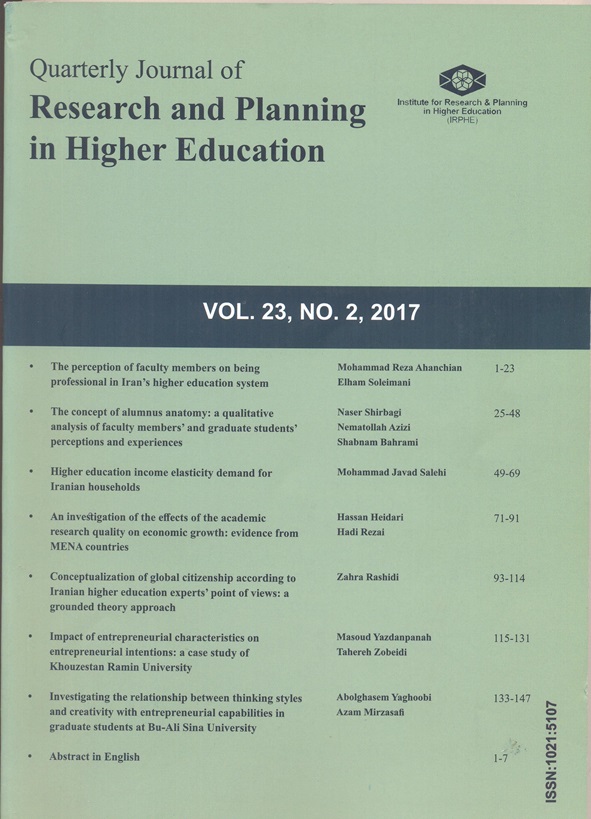
 Quarterly Journal of Research and Planning in Higher Education