1. Aghazadeh, M., & Asareh, A. (2008). Theories of globalization of education, their implications for curriculum and education. Proceedings of the 8th Conference of the Iranian Studies Curriculum Association, Globalization and Native Curriculum: Challenges and Opportunities, 8 and 9(in Persian).
2. Amani Ghazi, J. (2012). Global citizenship education in Jordanian universities. Procedia - Social and Behavioral Sciences, 47,1922- 1926.
3. Arefi, M., Ghahremani, M., & Rezaeizadeh, M. (2009). The necessity and practices of improving the curriculum of general courses from the viewpoint of students and faculty members of Shahid Beheshti University. Quarterly Studies of Curriculum, 3(10), 94-129(in Persian).
4. Delong, D.W. (2002). Diagnosing cultural barriers to knowledge management. Academy of Management Executive,14(4),113-127.
5. Eftekharzadeh, F. (2005). Study of the citizenship education framework for the future citizens of the 21st century. Tehran: Abed Publication (in Persian).
6. Farasatkhah, M. (2009). Evaluation of Iranian higher education quality: Application of basic theory. Publication: Higher Education Research and Planning Institute (in Persian).
7. Farasatkhah, M. (2016). Qualitative research method in social sciences with emphasis on "theory based" (Grounded Theory of GTM). Tehran: Informative Publishing (in Persian).
8. Farasatkhah, M., & Maniee, R. (2014). Factors affecting faculty members' participation in higher education policy planning and university planning. Quarterly Journal of Research and Planning of Higher Education (in Persian).
9. Farmahini Farahani, M. (2010). Citizenship education (history, approach, objectives, principles, necessity, dimensions, extensive studies, adaptive studies, curriculum). Tehran: Aijj Publishing (in Persian).
10. Fuller, T. (2009, September). Internationalization of the curriculum at BCIT. Report Adapted on the 2009 ASHE Conference Proposal for a Presentation in Van Couver.
11. Gawazi, A. (2008). Comparative, analytical study of the method of selecting and organizing the content of curriculum on social studies and citizenship education at the elementary education level of Iran with Sweden. Journal of Educational Innovations, No. 25(in Persian).
12. Geo-JaJa, M.A., Payne, S.J., Hallam, P.R., Baum, D.R., & Baum, D.R. (2009). Gender equity and women empowerment in Africa: The education and economic globalization nexus. In J. Zajda & K. Freeman, Globalization, comparative education and policy research, 12, 97-121.
13. Ghaderi, M. (2004). Understanding the program. Tehran: Book Release (in Persian).
14. Gordon, D.R. (2014). Curriculum integration versus educating for global citizenship: A(disciplinary) view from the international relations classroom. Frontiers: The Interdisciplinary Journal of Study Abroad, Vol. XXIV.
15. Gough, N. (2000). Locating curriculum studies in the global village. Journal of Curriculum Studies, 32(2), 329-342, Taylor & Francis, London.
16. Hamdi, K., & Razghi Shirsavar, H. (2013). Evaluation of university performance in improving citizenship education in metropolitan countries. Cultural Management, 5(13),(in Persian).
17. Hosseini Largani, M. (2015). Conceptualization of zayed curriculum in higher education. (Ph.D disiration). Shahid Beheshti University (in Persian).
18. Khosravi, M., & Ebrahimi, Z. (2005). Globalization and education. Proceedings of the First National Conference on Globalization and Education, Tehran University Press, Ministry of Foreign Affairs publication (in Persian).
19. Lincoln, Y.S., & Guba, E.G. (1985). Naturalistic inquiry. Beverly Hills, CA: Sage.
20. Mason, M. (2010). Sample size and saturation in PhD studies using qualitative interviews. Forum: Qualitative Social Research,11(3),8.
21. Mir Ahmadi, H. (2016). Globalization of Azad University. Translation (Ballamtine Books: New York, 1995) (in Persian).
22. Mok, M.M.C., & Cheng, Y.C. (2001). A theory of self- learning in a human international. Journal of Education Management,15, 172-186.
23. Scholte, J.A. (2000). Globalization: A critical introduction. London: Palgrave.
24. Seidman, I. (2006). Interviewing as qualitative research: A guide for researchers in education and the social sciences. Teachers College, Columbia University,3rd Edition.
25. Shah Talebi, B., Gholizadeh, A., & Sharifi, S. (2010). Formation of the elements of the citizenship culture in the areas of national and global identity for the students of the guidance school. Journal of Management and Educational Management, Islamic Azad University, Garmsar Branch, Number 2 (in Persian).
26. Sharifian, S., Amini, B., Gohari-Nejad, S., & Gandomkar, R. (2011). Explaining the understanding of Tehran University Medical Sciences students' understanding of the teacher's evaluation process: Expectations, challenges, strategies, steps in development of medical education. Journal of the Center for the Study of Education Development Medicine, 11(3), 763(in Persian).
27. Shekari, A., & Rahimi, A. (2007). Find and hide globalization. Tehran: New Thought (in Persian).
28. Smith, M.K. (2002). Globalization and the incorporation of education. Retrieved from http://www.Infed.org.
29. Stoner, L., Perry, L., & Wadsworth, D. (2014). Global citizenship is key to securing global health: The role of higher education, Preventive Medicine, 64,126-128.
30. Strauss, A., & Corbin, J. (1998). Basics of qualitative research: Techniques and procedures for developing grounded theory. Sage Publications, Inc.
31. Strauss, A.L., & Corbin, J.M. (2013). Basics of qualitative research (3e), Basics of qualitative research, Techniques and procedures for developing grounded theory. Thousand Oaks, USA: Sage.
32. Takkac, M., & Akdemir, A. (2012). Training future members of the world with an understanding of global citizenship. Procedia- Social and Behavioral Sciences, 47.
33. Yarmohammadian, M. (2016). Principles of educational planning, Book Remembrance (in Persian).
34. Zohbyun, Sh., & Elyasi, F. (2014). Analysis the relationship between sustainable development and global citizenship curriculum. Publisher: Sevilleka (in Persian).
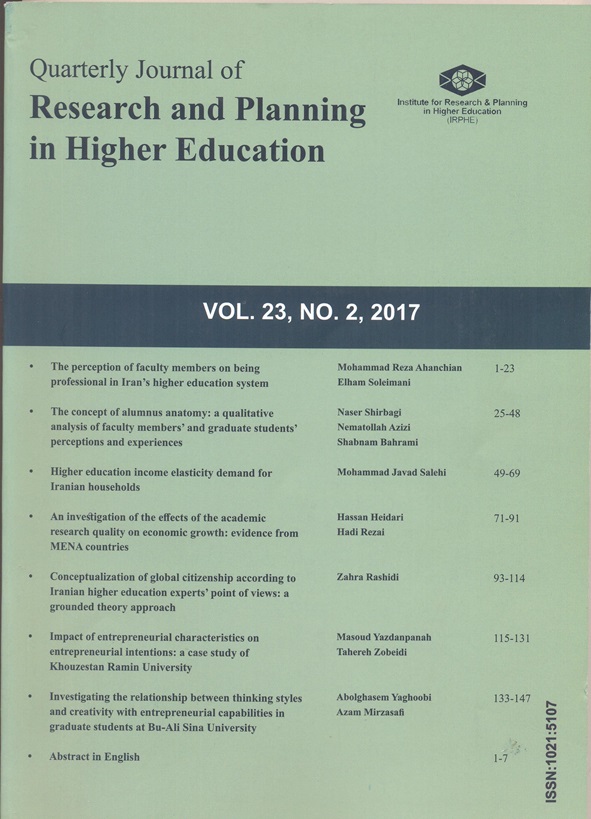
 Quarterly Journal of Research and Planning in Higher Education