Department of Economics of Higher Education and Manpower, Institute for Research and Planning in Higher Education
Abstract
Higher education is an economic good like other goods and services that households, according to their income, have sensitivity to it. This sensitivity is an indicator for assessing household elasticity income for higher education demand. Therefore, in this study the attitude of households toward higher education was examined. The main objective of this study was to calculate higher education income elasticity demand for Iranian households. The major question was: is higher education a kind of luxury, necessary or inferior good for Iranian households? By using a quantitative method and utilizing data from Statistic Center of Iran, the income elasticity demand for urban and rural households during 2005-12 was calculated for 2012 by income deciles. The results showed that the higher the income growth, higher education as luxury goods has become an essential commodity for Iranian households. Consequently, the major hypothesis of this study is accepted. In addition, over time higher education has become an essential commodity for urban and rural households.
1. Abounouri, E., & Iraji, F. (2006). Cost structure of households in Khorasan province and its comparison with the whole country. Quarterly Journal of Knowledge and Development, (16) (in Persian).
2. Ansari, A., & Mohammadi, T. (2010). Grouping urban households and analyzing their demand for education. Education Quarterly, (1) (in Persion).
3. Dax, P. (1987). Estimation of income elasticities from cross section data. Applied Economics.
4. Ghorouri Nakhjavani, A. (2005). Poverty in Iranian households. Social Welfare Quarterly, 4 (17) (in Persian).
5. Giles, D.E.A., & Hampton, P. (1985). An Engel curve analysis of household expense.
6. Khodadad, F., & Heydari, Kh. (2011). The role of education in Iranian household ’s expenditure basket. Quarterly Journal of Economic Growth and Development Research, 1 (2) (in Persian).
7. Massel, B.F. (1967). Consistent estimation of expenditure elasticities from cross- section data on households producing partly for subsistence. England: food Research Institute. Stanford University.
8. Mollaie, M., & Moradi, H. (2010). Investigating and comparison of commodity consumption of Iranian households. Social Welfare Quarterly,10 (37) (in Persian).
9. Naderi, A. (2004). Education economics. Tehran: Yastaroun (in Persian).
10. Prais, S.J. & Houthakker, H.S. (1971). The analysis of family budgets. Cambrige.
11. Salehi, M. (2014). The share of higher education in the cost basket of Iranian households. Research Project: Institute for Research and Planning in Higher Education (in Persian).
12. Sarpkaya, R. (2010). Factors affecting individual education demand at the entrance to university educational sciences: Theory & Practice. 475-488.
13. Statistical Center of Iran) 2005-2012). Investigation results from the cost and income of the urban and rural households.
Salehi, M. J. (2023). Higher education income elasticity demand for Iranian households. Quarterly Journal of Research and Planning in Higher Education, 23(2), 49–69.
MLA
Salehi, M. J. "Higher education income elasticity demand for Iranian households", Quarterly Journal of Research and Planning in Higher Education, 23, 2, 2023, 49–69.
HARVARD
Salehi, M. J. (2023). 'Higher education income elasticity demand for Iranian households', Quarterly Journal of Research and Planning in Higher Education, 23(2), pp. 49–69.
CHICAGO
Salehi, M. J., "Higher education income elasticity demand for Iranian households." Quarterly Journal of Research and Planning in Higher Education, 23 2 (2023): 49–69,
VANCOUVER
Salehi M. J. Higher education income elasticity demand for Iranian households. Quarterly Journal of Research and Planning in Higher Education. 2023;23(2):49–69 (In Persian).
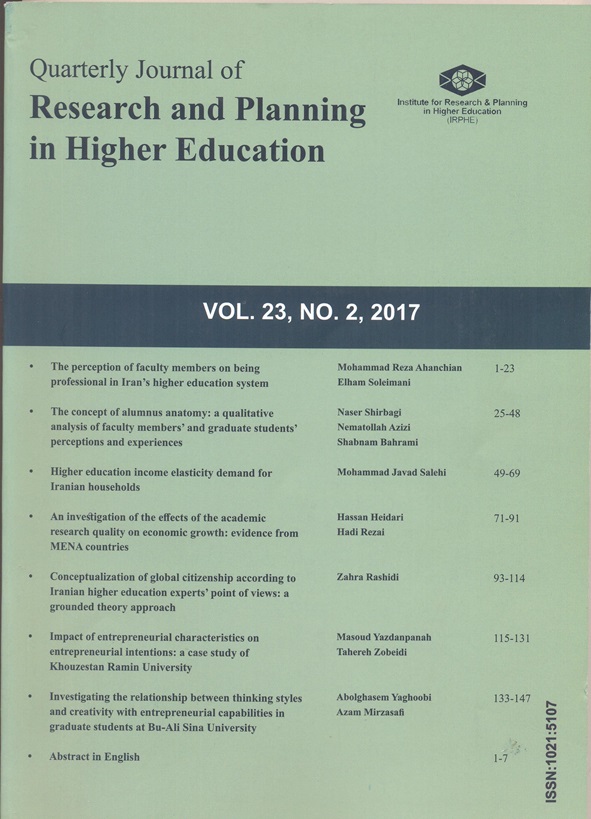
 Quarterly Journal of Research and Planning in Higher Education