. Aghadavoud, S.R. (2010). Major challenges of Iran’s higher education system. Natinal Conference on Challenges of Management and Leadership in Iranian Organization, Islamic Azad University, Science and Research Branch (in Persion).
2. Ahmadpour Daryani, M., Davari, A., & Ramezanpoor Nargesi, G. (2010). Encouraging business environment, prerequisite of entrepreneurship development in Iran. Management Studies in Development & Evolution, 17)61(, 65-89 (in Persion)
3. Ashrafi, Y., & Fahimifar, F. (2011). The evaluation of business indicators improvement with focused on Iran as case study. Monthly Quarterly Journal of Economic Research and Policies, 11, 7-42 (in Persion).
4. Azhdari, A. (2005). The survey of relationship between university and industry and government function in Iran. Infrastructure Studies, 7626, Retrieved from rc. majlis.ir/m/report/download/731147 (in Persion).
5. Bakhtiari, S., & Shayesteh, A. (2012). The effect of improving the business environment on economic growth in selected countries, with emphasis on Iran. Quarterly Journal of Management System (Financial Economics and Development), 6(19), 175-204 (in Persian).
6. Barro, R. J., & Lee, J. (2010). A new data set on educational attainment world 1950-2010. NBER Working Paper No 15902, Retrieved from www.nber.org/papers/w15902.pdf.
7. Barro, R.J., & Lee, J. (2000). International data on educational attainment: Updates and implications. Center for International Development at Harvard University, Working Paper 42, Retrieved from www.cid.harvard. edu/cidwp/pdf/042.pdf.
8. Blundell, R., Dearden, L., Meghir, C., & Sianesi, B. (1999). Human capital investment: The returns from education and training to the individual, the firm and the economy. Fiscal Studies, 20(1), 1-23.
9. Chaharband, F., & Momeni, F. (2011). Challenges and perspectives in knowledge based development in Iran: Basic education approach. Iranian Journal of Economic Growth and Development Research, 1(4), 116-75 (in Persion).
10. Cheng, B. S., & Hsu, R. C. (1997). Human capital and economic growth in Japan: An application of time series analysis. Applied Economics Letters, 4, 393-395.
11. Furubotn, E.G., & Richter, R. (2000). Institutions and economic theory: The contribution of the new institutional economics. Ann Arbor, MI: The University of Michigan Press.
12. Gholipor, R., & Aghabozorgi, M. (2003). A review on the relationship between industry and university. The Brue of Cultural Studies, Higher Education Committee, 6677, Retrieved from c.majlis.ir/m/report/ download/733223 (in Persian).
13. Harris, G.R., Robertson, P.E., & Xu, J.Y. (2010). The international effects of China’s growth, trade and education booms. Discussion Paper, No. 10.04.
14. Heidari, H., Dabbag, R., & Sanginabadi, B. (2011). The effect of higher education on economic growth in Iran: An application of bounds test approach. Qurterly Journal of Research and Planing in Higher Education, 59, 115-136 (in Persion).
15. Hurlin, C. (2007). Testing granger causality in heterogeneous panel data models with fixed coefficients. Working Paper, LEO, University of Orleans.
16. In, F., & Doucouligos, C. (1997). Human capital formation and economic growth: A causality analysis. Applied Economics Letters, 4, 329-331.
17. Jafari, P., & Ahmadi, A. (2010). Investigating the role of higher education in knowledge economy in order to presenting a suitable model. Journal of Foresight Management Research, Islamic Azad University, Science and Research Branch, 87, 113-134, (in Persion).
18. Khorshidi, G. (2004). Higher education economy. Ministry of Science, Research and Technology, Cultural and Social Dept., Office of Social Planning and Cultural Studies. Retrieved from http://fardiha.blogfa.com/ post-80.aspx (in Persion).
19. Kim, S., & Kim, Y. (2000). Growth gains from trade and education. Journal of International Economics, l (50), 519- 545.
20. Kim, Y. (2000), Concurrent development of education and industrialization strategies in Korea (1945-95). Journal of Education and Work, 13(1), 55-83.
21. Mahnegar, F., & Peykarifar, F. (2012). Investigating the role of universities in enterpronorship development. National Conference on Enterpronurship and Knowledge Based Bussiness’ Management, University of Mazandaran (in Persion).
22. McDowell, C.W., & Voelker, A.T. (2008). Information, resources and transaction cost economics: The effects of informal network centrality on teams and team performance. Journal of Behavioral and Applied Management, 9(2), 134-147.
23. Mehrgan, N., Ezzati, M., & Asghar Pour, H. (2006). Investigating the causal relationship between interest rate and inflation by applying panel data. Quarterly Journal of Economic Researche, 3, 91- 105 (in Persion).
24. North, D. C. (1989). Institutions and economic growth: An historical introduction. World Development, 17(9), 1319-1332.
25. North, D. C. (1990). Institutions, institutional change and economic performance. Cambridge and New York: Cambridge University Press.
26. North, D.C. (2000). Revolution in economics. In Menard, C. (ed.). Institutions, contracts and organizations: Perspectives from new institutional economics. Cheltenham: Edward Elgar.
27. Renani, M. (1997). Market or not market, Tehran: Samt Press, Secon Edition (in Persion).
28. Sharifzadeh, F. (2011). The necessity of reidentifying educational system and its role regarding country’s social-scientific development: A research on university undergraduate public administration program. Journal Management System, 2(1), 79-112 (in Persion).
29. Smith, A. (1978). The Wealth of Nations. Translation by Ebrahimzadeh, S., Payam Publications (in Persian).
30. Tayebi, S.K., Zamani, Z., & Karimi, N. (2015). A scenario on business environment improvement and production growth of Iran’s economic sectors in post-sanction era. 2th Conference on Business Environment Improvement, December 14, The Headquarters of The Islamic Summit, Tehran, Iran (in Persian).
31. Tayebi, S.K, Zamani, Z., Sarmadi, H., & Razavi, S.A. (2013). The role of transaction cost and business environment improvement on SMEs trade development in selected Asian countries. 19th National Conference on Non- Oil Export Development, Tabriz Chamber of Commerce, Industries, Mining and Agriculture, Tabriz, Iran (in Persian).
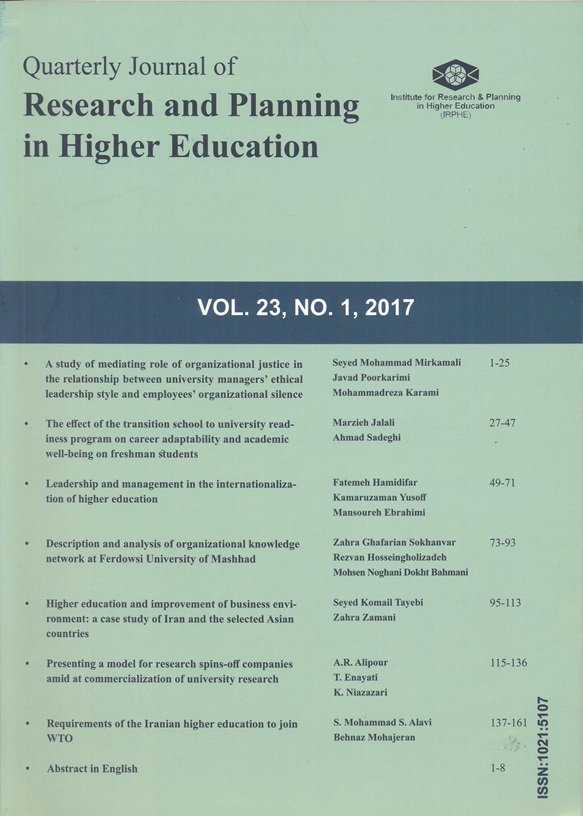
 Quarterly Journal of Research and Planning in Higher Education