1. Azar, A., & Torkashvand, A. (2006). Evaluation of educational and research performance with DEA method. Tarbiat Modares University, Journal of Human Sciences Teacher, 10, 1-24 (in Persian).
2. Gacia-Aracil, A. (2008, September). Evaluation of Spanish Universities: Efficiency, Technology and Productivity Change. Paper presented in the Prime-Latin America Conference at Mexico City, September 24-26.
3. Avkiran, K. (1999). Investigating technical and scale efficiencies of Australian Universities' through data envelopment analysis. Socio Economic Planning Sciences, No. 35.
4. Banker, R.D., Charnes, A., & Cooper, W.W. (1984). Some models for estimating technical and scale inefficiencies in data envelopment analysis. Management Science, 30, 1078-1092.
5. Charnes, A., Cooper, W.W., & Rhodes, E. (1978). Measuring the efficiency of Decision Making Units. European Journal of Operational Research, 2, 429-444
6. Dabbagh, R., Baradaran Shoraka, H.R., & Feyzi, S. (2010). Identifying indicators to evaluate the performance of universities in the country using fuzzy logic. Journal of Psychology and Education, Tehran University, 40(2) (in Persian).
7. Emami Meibodi, A. (2005). Principles of efficiency and productivity measurement (scientific-practical).Tehran: The Institute for Trade Studies & Research, 2eds Edition (in Persian).
8. Fazli, Z. (2002). Mathematical modeling managers, performance assessment using data envelopment analysis. Journal of Humanities Teacher, 6(26), 99-124(in Persian).
9. Forsund, F.R., & Kalhagen, K.O. (1998). Efficiency and productivity of Norwegian colleges. Department of Economics, University of Oslo.
10. Flegg, A.T., Allen, D.O., Field, K., & T.W. Thurlow, T.W. (2004). Measuring the efficiency of British Universities: A multi- period data envelopment analysis. Education Economics, 12(3), 231-249.
11. Heidarinejad, S., Mozafari, A., & Mohaghar, A. (2006). Assessment of physical education faculties and departments at state universities with mathematical model DEA. Journal of Olympic, 34, 7-18 (in Persian).
12. Pour-Kazemi, M.H., Samsami, H., & Ebrahimi Ghavam Abadi, Kh. (2011). The efficiency and productivity of public and private insurance companies using DEA and Malmquist Index. Journal of Insurance, 26(4), 1-26(in Persian).
13. IssaKhani, A. (2002). Model evaluates the performance of departments using DEA Tarbiat Modarres University. (Master thesis). Tarbiat Modarres University (in Persian).
14. Johnes, J. (2006). Efficiency and productivity change in the English higher education sector from 1996/97 to 2002/03. Lancaster University Management School, United Kingdom. Working Papers.
15. Molaei, M., Jahanshahi, H., & Ghazizadeh, SZ. (2011). Assessing the efficiency of research and development (R&D) centers with window data envelopment analysis approaches. 3rd National Conference on Data Envelopment Analysis, Azad University, Firouzkooh Branch (in Persian).
16. Momeni, A. (2004). Using dynamic model design productivity DEA. School of Humanities, TarbiatModarres University (in Persian).
17. Tavakkoli Moghaddam, R., Sadegh Amal Nik, M., & Rafati, M.A. (2004). Methodology using DEA research organizations. College of Engineering, 38(1), 175-185 (in Persian).
18. Vocabulary Terms (2007). The Ministry of Science, Research and Technology, The Institute for Research and Planning in Higher Education (in Persian).
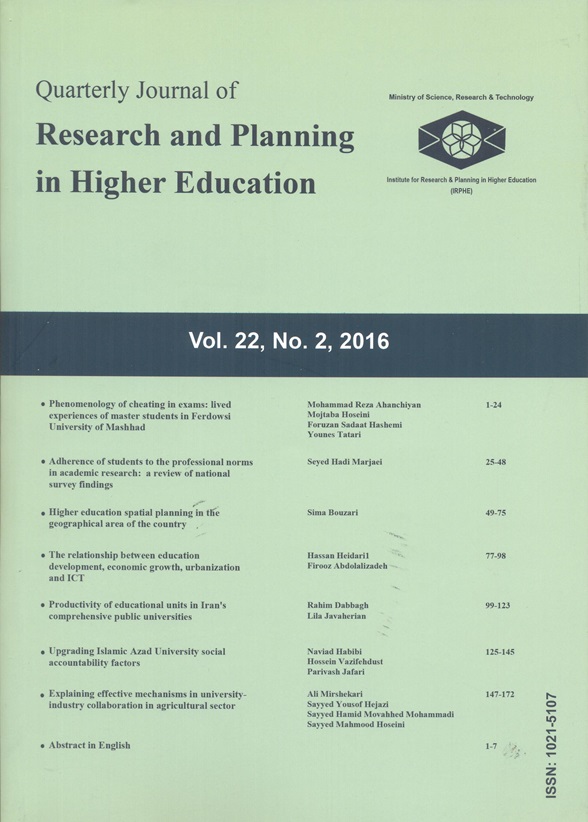
 Quarterly Journal of Research and Planning in Higher Education