1. Abbasi, R. (2013). The relationship between cultural capital and social capital of Artists. (Master's thesis). Tabriz, Islamic Azad University, P. 47 (in Persian).
2. Akbarzadeh, F., Dehghani, H., Khoshfar, GH., & Janalizadeh, H. (2014). Evaluation of three types of economic capital, cultural and social youth happiness. Applied Sociology, (49), 67-88 (in Persian).
3. Birou, A. (1992). Dictionary of social sciences. Translated by Bagher Saroukhani, Tehran: Keihan, P. 275 (in Persian).
4. Farasatkhah, M. (2009). University and higher education, global perspectives and problems in Iran. Tehran: Ney (in Persian).
5. Fazeli, N. (2008). Culture and university. Tehran: Sales (in Persian).
6. Fazeli, N. (2013). Academic Man. Retrieved from http://www.farhangshenasi.com/persian/node/690 (in Persian).
7. Field, J. (2007). Social capital. Translated by Ghaffari, GH. & Ramezani, H., Tehran: Kavir, 27-98 (in Persian).
8. Ghaneirad, M. A. (2006). Interactions and communication in the scientific community (case study: social sciences). The Office of Social and Cultural Studies, Ministry of Science and Management Iranian Sociological Association, a social sciences (27) (in Persian).
9. Ghaneirad, M. A. (2006). The role of interactions between students and professors in the university's development of social capital. Iranian Journal of Sociology, 7(1), 3-29 (in Persian).
10. Ghazi Tabatabayi, M., & Marjaei, S.H. (2001). Effective factors on college students ' self-efficacy. Quarterly Journal of Research and Planning in Higher Education, 7(19), 31-58 (in Persian).
11. Grenfell, M. (2008). Pierre Bourdieu: Key concepts. Transated by Mehdi Labibi, Tehran: Naghde Afkar, 105-106 (in Persian).
12. Knublakh, H. (2011). Principles of sociology of knowledge. Translated to Rasekh, K., Second Edition, Tehran: Ney, 209-221 (in Persian).
13. Koppi, A. J., Chaloupka, M. J., Llewellyn, R., Cheney, G., Clark, S., & Fenton-Kerr, T. (1998). Academic culture flexibility and the national teaching and learning database. ASCILITE 98 Conference Proceeding, 425-32.
14. Marjaei, S.H. (2006). Measurement of self-efficacy in Job decision-making in university students. Institute for Research and Planning in Higher Education (in Persian).
15. Mohseni Tabrizi, A.R. (2001). Study of youth social pathology isolation values and cultural participation in the country's media, public university students in Tehran. Institute for Research and Planning in Higher Education (in Persian).
16. Mohseni Tabrizi, A.R., Ghazi Tabatabayi, M., & Marjaei, S. H. (2009). An analysis of the basic problems of the scientific community college campuses in Iran. Journal of Contemporary Sociology, 2(1), 79-102 (in Persian).
17. Putnam, R. (2005). Democracy and civil traditions. Translated by Delfouros, M.T., Tehran: Office of Political Studies and the Ministry of Interior, 137-292 (in Persian).
18. Rafipoor, F. (2002). Obstacles to scientific development in Iran and solutions. Tehran: Enteshar (in Persian).
19. Rasteghar Khaled, A., Mohammadi, M., & Pakbaz, S. (2014). Study the relationship between the cultural capitals of young people with their quality of life in Tehran. Quarterly Journal of Social Development, 7(4) (in Persian).
20. Seidman, S. (2006). Contested knowledge. Transated by Hadi Jalili, Tehran: Ney, 198-200 (in Persian).
21. Shafer, N.J., & Danil, M. (2008). Conceptual foundations of social capital. Translated by Shojaei Baghini, M.M., & Colleagues, Tehran: Research Institute of Social and Cultural Studies, 54-58 (in Persian).
22. Shampaien, P. (2012). Pierre Bourdieu. Translated by Moaiyed Hekmat, N., Tehran: Research Institute of Humanities and Cultural Studies, P.31.
23. Sharepour, M. (2009). Sociology of Education. Tehran: Samt (in Persian).
24. Sharepour, M. (2010). Study the factors affecting social trust in police, Case Study: Mazandaran province. Applied Sociology, 20(36), 10-16 (in Persian).
25. Tajbakhsh, K. (2005). Social capital, trust, democracy and development. Translated by Khakbaz, A. & Pouyan, H., Tehran: Shyrazeh, 51-292 (in Persian).
26. Tayefi, A. (1999). Iran's scientific culture: A review of the capabilities and limitations. Journal of Rahyaft, 21, 47-53 (in Persian).
27. Wada, K. (2008). Opportunity for development of academic culture in the super science high school project. Polyglossia, 14.
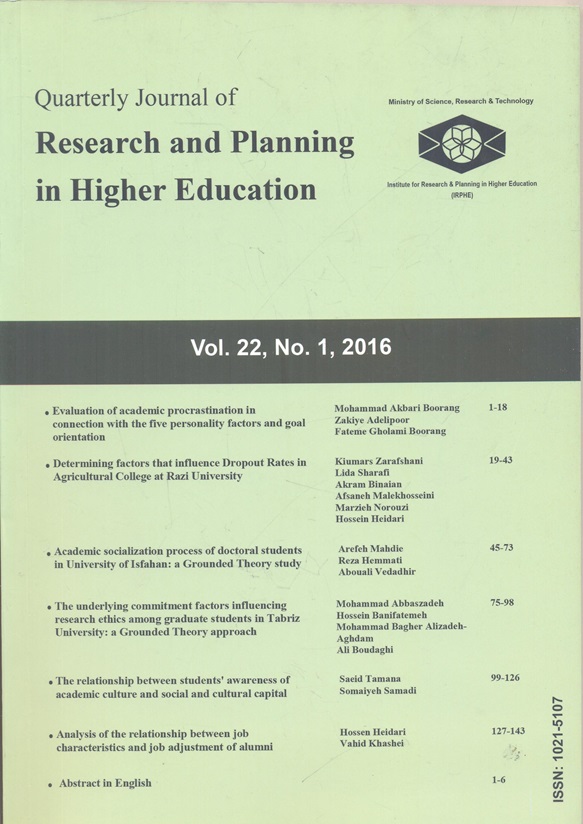
 Quarterly Journal of Research and Planning in Higher Education