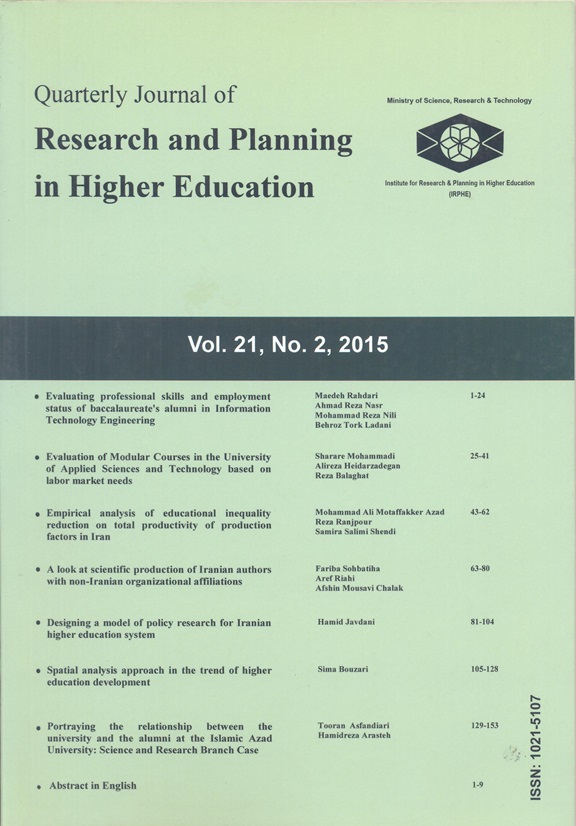
Empirical analysis of educational inequality reduction on total productivity of production factors in Iran

Authors
1 Department of Economics, Faculty of Economics, Management and Business, Tabriz University
2 MSc Student in Economics, Tabriz University
Abstract
Education, as one of the concepts of human capital, transfers various capabilities to the labor force and increases productivity and efficiency of the work. The purpose of this study was to investigate the effect of educational inequalities on the total productivity of production factors in Iran. In this context, the Gini coefficient of education was calculated using the study by Thomas et al. (2001) as an indicator for defining the inequalities of education for 15 year old and older individuals. Then, using time series data over the period of 1970-2011 in Iran and ARDL econometric approach, the degree of educational inequality and its experiential relationship with total productivity of production factors have been tested. Based on the obtained results, there is a significant negative relationship between the educational Gini coefficient and total productivity of production factors in the short term and long term. In other words, decreasing of educational inequalities increases the overall productivity of production factors.

Keywords


  • Receive Date 06 March 2023
  • Publish Date 06 March 2023