1
School of Educational Sciences and Psychology, Ferdowsi University, Mashhad
2
PhD Student in Assessment and Measurement, Allameh Tabatabai’ University
Abstract
The purpose of this study was to evaluate research self–efficacy among students and assess their strengths and weaknesses in this area. The research method was evaluation and factor analysis was used to evaluate factor structure of the questionnaire. The sample included 300 graduate students in Ferdowsi University who were selected from the six faculties by quota sampling method. In this study the Research Self Efficacy scale (RSE) that was developed by Bieschke, Bishop & Garcia and Interest in the Research Questionnaire (IRQ) that was developed by Bieschke and Bishop were used to gather data. The content validity was confirmed by review of experts and construct validity was confirmed by factor analysis. The results of exploratory factor analysis through the principal component showed that, four factors are extracted and this factors explained 65% of the variance of research self-efficacy. The convergent validity showed that, there is a correlation between research self- efficacy questionnaire and interest in the research questionnaire(r=0.44). Internal consistency showed that, there are high alpha coefficients for both the overall research self- efficacy (0.97) and for factors (from 0.75 to 0.95). The results of evaluation of research self-efficacy components showed that, students have a high ability in some skills such as: Research self-efficacy scores, doing early tasks of research, the cooperation ability in research, ability to perform research and analysis and presentation of results. Furthermore, there was a significant difference between students' research self-efficacy components. There was significant difference in term of ability in doing early task of research, administrating research and analyzing data and present ting the results, among students in different faculties as well. It is necessary to formulate policies and provide the training to increase skills such as cooperation in research and doing early tasks of research. Moreover, it is recommended to use the research self- efficacy scale to measure the level of research self- efficacy of students.
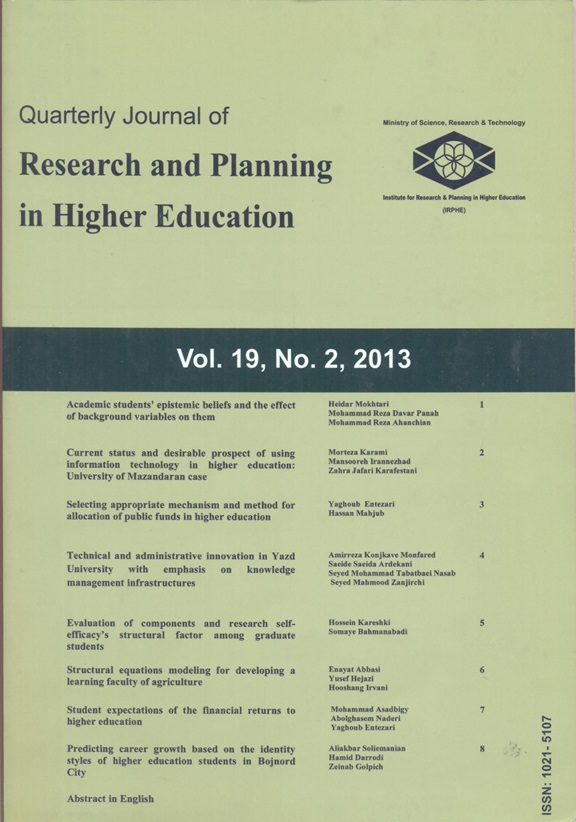
Kareshki, H. & Bahmanabadi, S. (2023). Evaluation of components and research self â efficacyâs structural factor among graduate students. Quarterly Journal of Research and Planning in Higher Education, 19(2), 91–114.
MLA
Kareshki, H., & Bahmanabadi, S. "Evaluation of components and research self â efficacyâs structural factor among graduate students", Quarterly Journal of Research and Planning in Higher Education, 19, 2, 2023, 91–114.
HARVARD
Kareshki, H., & Bahmanabadi, S. (2023). 'Evaluation of components and research self â efficacyâs structural factor among graduate students', Quarterly Journal of Research and Planning in Higher Education, 19(2), pp. 91–114.
CHICAGO
Kareshki, H. & Bahmanabadi, S., "Evaluation of components and research self â efficacyâs structural factor among graduate students." Quarterly Journal of Research and Planning in Higher Education, 19 2 (2023): 91–114,
VANCOUVER
Kareshki H., Bahmanabadi S. Evaluation of components and research self â efficacyâs structural factor among graduate students. Quarterly Journal of Research and Planning in Higher Education. 2023;19(2):91–114 (In Persian).
 Quarterly Journal of Research and Planning in Higher Education